What are Hair Prosthetics? Are the outcomes of the Hair Prosthetic permanent?
Free Video Consultation

Category: Alopecia Areata

What are Hair Prosthetics? Are the outcomes of the Hair Prosthetic permanent?

Hair Prostheses: Uses, Maintenance, Skin Safety and Realistic Expectations

Loading

A hair prosthesis is a non-surgical option for concealing partial or extensive hair loss. Depending on the design, it may be attached with clips, tapes, adhesives or other fitting systems. It can improve cosmetic coverage, but it does not treat the medical cause of hair loss or make follicles regrow.

Who may consider a hair prosthesis?

People with alopecia areata, scarring alopecia, diffuse thinning, treatment-related hair loss or advanced pattern hair loss may consider a wig, topper or custom prosthesis. The most suitable option depends on scalp condition, the amount and pattern of hair loss, lifestyle, budget and maintenance preferences.

Before choosing a cosmetic system, unexplained or rapidly progressing hair loss should be medically assessed. Some causes of hair loss need treatment even if a prosthesis is being used for appearance.

What a prosthesis can and cannot do

A well-fitted system can provide immediate visual coverage and may be customised for colour, length, density and hair texture. The result, however, should not be described as universally “completely natural” or permanent. Appearance depends on the product, fitting, hairline design, maintenance and wear over time.

A prosthesis also does not stop future hair loss. It is different from hair transplantation, which moves a patient’s own follicles from a donor area to selected recipient areas and has its own candidacy limits and surgical risks.

Skin and adhesive considerations

Adhesives and tapes can cause irritation, allergic contact dermatitis, folliculitis or skin breakdown in some users. People with eczema, psoriasis, active infection, wounds or a sensitive scalp should discuss attachment methods before using adhesive-based systems. A patch test or alternative fixation method may be appropriate in selected cases.

Daily activity and maintenance

Swimming, showering, exercise, sleeping and styling rules vary by system. Some products can tolerate more activity than others, while repeated moisture, heat, friction or chemicals can shorten product life or irritate the scalp. Follow the manufacturer’s and fitter’s care instructions rather than treating every prosthesis exactly like natural hair.

Regular cleaning, scalp hygiene and scheduled refitting may be needed. Replacement intervals vary widely with material quality, attachment method, frequency of wear and maintenance, so a fixed lifespan should not be promised.

Cost and follow-up

Cost depends on whether the system is synthetic or human hair, stock or custom-made, the attachment method, servicing and replacement needs. A single universal price range is not reliable because ongoing maintenance can be a substantial part of total cost.

For help understanding the underlying cause of hair loss, see our Hair Loss guide. To discuss whether a non-surgical prosthesis or surgical restoration may be appropriate, use the Contact Us page.
Scarring Alopecia Symptoms, Causes, Treatments, and More

Scarring Alopecia Symptoms, Causes, Treatments, and More

Loading

The current population is facing variable disorders which were unheard of in the yesteryear. The most common of them is hair loss. It might strike some early in life, but it is usually seen striking people when they reach middle ages. The reasons lie mainly in genetics, stress, medication or certain medical conditions.Many people take up treatments to revive their crowning glory but if they fail to see results after using these methods, they finally opt for a hair transplant. Of the diseases which cause extensive hair loss, cicatricial alopecia is the most common. Let us take a look at what exactly the disease does to our hair.

Scarring Alopecia

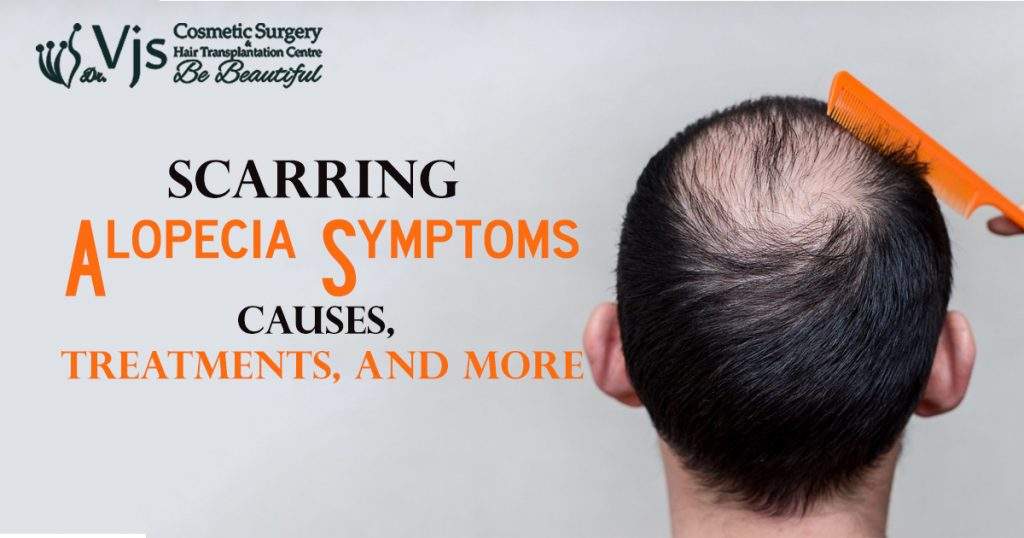
It is a condition which occurs in men and women and is responsible for 3% of the hair loss patients.It is characterized by destruction of hair follicles and replacement of the same by a scar tissue. It appears in the form of bald patches on the hair which expand as time passes. In certain cases, the hair loss may be so gradual that it goes unnoticed. In some other cases, the hair loss may be accompanied with severe itching, pain and a burning sensation.

The symptoms

Scarring alopecia differs from alopecia areata in the manner that the scalp looks rougher in this condition. The bald patches can be seen in both the cases but the appearance of the skin of the scalp is different in each. Sometimes, the scalp may be smooth or it may have redness, scaling or pigmentation. There may even be the presence of blisters with pus in them.

The diagnosis

Physical signs often point to the presence of Scarring alopecia but it is not enough to for an accurate diagnosis.The doctor might perform one or two biopsies to confirm his suspicion. A small piece measuring from 2 to 4 mm diameter is taken and observed under a microscope. The concerned pathologist will try to look for signs of destruction of follicles, inflammation, and appearance of scar tissue at skin deep levels. While the inflammation levels may not show correctly, one thing is for sure: the destruction of hair follicles. Once they are destroyed,only  a scarred tissue remains.  Once the disease burns out, the itching, inflammation and the redness vanishes but the hair follicles remain inactive as they are destroyed. The follicles at the periphery might not be destroyed and they may give rise to some hair.

Treatment Options

As the disease causes extensive damage to the hair follicles,the medication and treatment should be swift in action and highly effective. Scarring alopecia which involves lymphocyte inflammation of hair follicles is treated with the application of creams containing corticosteroids. Antimalarial and isotretinoin drugs may be used in conjunction to achieve better results. Another line of treatment includes administration of antibiotics along with isotretinoin. These are used when the inflammation strikes mostly neutrophils or a mixture of cells. Methotrexate, thalidomide, cyclosporine, tacrolimus can also be used. The disease is known to burn out at the end. If it so happens and there has been no evident hair loss since a few years, the bald patches can be removed or treated with hair transplant method. If the bald patches are small, then they can be surgically removed.

What Is Alopecia Areata (Patchy hair loss) and how do I Treat It?

What Is Alopecia Areata (Patchy hair loss) and how do I Treat It?

Loading

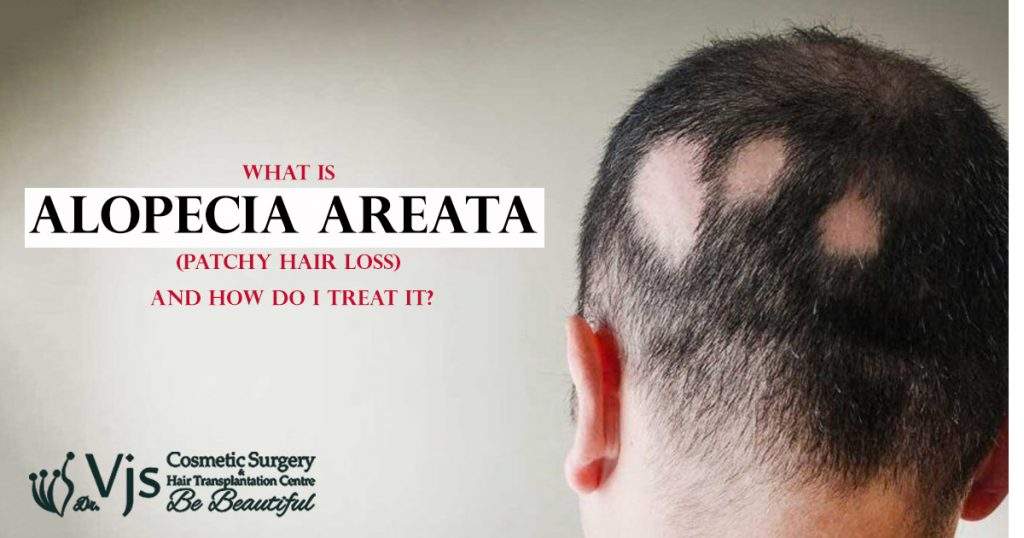
If you have lately seen lots of hair on your bed, shower drain, comb, and brush, everywhere but where they are supposed to be, you may be suffering from a chronic disease called Alopecia areata.

Having a chronic disease means, your immune system pounces your own body. When someone has alopecia areata, the hair follicles get pounced. The hair loss differs in every person in Visakhapatnam, Andhra Pradesh. Some people have it more while others have it less. Though a rare disease, when it occurs it can make the person suffering lose all hair on the head.

Many times hair grows back but again falls later on. You can check with a specialized doctor, in case you are also suffering from the same.

Following are the causes of Alopecia areata

  • This happens when WBC’s or White Blood cells strike the cells present in hair follicles, which induce them to diminish in size and also to slow down the production of hair, any further. Even doctors are not sure why this destruction takes place; sometimes it seems that genes have a role to play in this condition. Because many times it is seen that Alopecia areata happens in those people who already have someone with this disorder in the family.
  • People who have it in their family also might be suffering from some other autoimmune disease, like atopy, which is said to be related to being in those who are hyper allergic or someone suffering from thyroid.
  • Stress is also one of the causes of suffering from Alopecia areata. Extreme levels of stress can damage the condition.

What can be done to cure it?

You can try doing the under mentioned things:

  • Minoxidil (Rogaine).This has to be applied on the scalp. It will take around 3 months to see full results.
  • This works like a steroid, they are medicines prescribed for the disorder. They are available in the form of an injection which is injected into scalp or other places.
  • Adoptive Immunotherapy, This is used when drastic hair loss takes place, or if it keeps recurring. Chemicals are supposed to be applied to obtain a reaction. In the case of it working, the reaction is what will make the hair grow.
  • One can wear hats, beret, scarves, etc. All of these help in covering hair loss and also in safeguarding your head from the blistering sun.
  • By reducing unnecessary stress also one is able to take control of hair loss.
  • Alopecia areata causes worry and tension to the person having it. You can join support groups which will help you deal to come out of it.
  • Even if a lot of hair is lost, even then you can grow them back. And if they don’t grow back, there are many more options like hair transplant to have them back.
```html ```