
PRP Treatment for Hair Loss in Kakinada: Evidence, Process & Risks
PRP Procedure Video
Where PRP May Fit in a Hair-Loss Plan
PRP is made from a patient’s own blood and is used as an injectable scalp treatment in selected hair-loss cases. It is most often discussed for androgenetic (pattern) hair loss, but the evidence does not support presenting it as a universal regrowth treatment.
A Kakinada consultation should begin with the pattern and pace of hair loss, scalp examination and relevant medical history. Patchy loss, sudden shedding, scarring disorders, active scalp inflammation or nutritional and endocrine causes may require a different diagnostic pathway before PRP is considered.
If PRP is proposed, ask what outcome is being targeted, how progress will be measured and what other treatments may still be needed. VJ Clinics lists a Kakinada location; availability of the procedure and the clinician responsible for treatment should be confirmed when arranging an assessment.
Procedure of PRP
A typical scalp PRP procedure starts with drawing a small amount of blood and processing it in a centrifuge to obtain a platelet-rich fraction. The prepared PRP is then injected into selected scalp areas using sterile technique.
PRP preparation systems differ in platelet concentration, white-cell content and activation methods, so protocols are not identical across clinics. The number and spacing of sessions should be individualized rather than presented as one fixed schedule for everyone.
Ask which system is being used, who performs the injections, what infection-control measures are followed and what evidence supports the proposed plan.
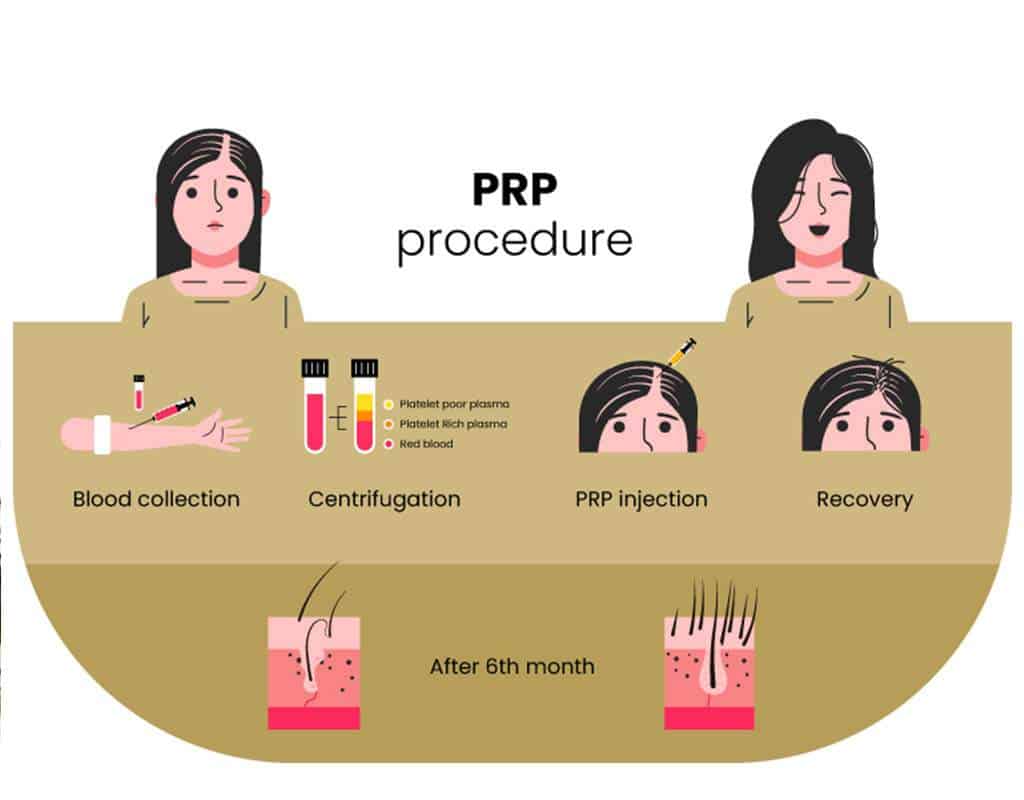
RECOVERY
After PRP injections, temporary scalp tenderness, swelling, bruising or headache can occur. Whether local anaesthetic, pain relief or other medication is used depends on the individual and clinic protocol.
Hair changes are not expected within a few days. When PRP helps, improvement is generally assessed over months, and response varies between patients. Existing hair-loss treatment may still be needed depending on the diagnosis.
Follow the treating clinician’s instructions on washing, exercise, sun exposure and scalp products rather than relying on a universal aftercare schedule.
Complications
PRP is derived from the patient’s own blood, but that does not make the procedure risk-free. Possible risks include pain, swelling, bruising, bleeding, infection, temporary headache, vasovagal symptoms and, rarely, injury to nearby tissue.
People with certain blood disorders, active infection or other medical conditions may need additional assessment or may not be suitable for treatment. Risks should be discussed as part of informed consent.
Can you opt for PRP?
PRP is not automatically appropriate for nearly everybody. Suitability depends on the diagnosis and medical history. A clinician may need to consider platelet or bleeding disorders, active infection, significant anaemia, anticoagulant or antiplatelet treatment, immune conditions, cancer treatment and other relevant health factors.
Smoking or alcohol use should be discussed because they can affect general health and healing, but they are not universal reasons to deny treatment without an individual assessment. Do not stop prescribed medicines unless the prescribing clinician and treating doctor specifically advise it.
Potential Advantages and Important Limitations
PRP uses a preparation made from the patient’s own blood, which reduces the risk of a donor-related immune reaction. It does not eliminate infection, bleeding, pain or other side effects, and it should not be described as completely safe.
The procedure does not require a surgical incision, but it still involves multiple needle injections. Some people return to routine work quickly, while others may prefer short downtime because of tenderness or swelling.
Potential benefit depends on the type of hair loss and individual response; results are not guaranteed.
PRP in today's context
PRP has been studied in several medical fields. For hair loss, evidence is most supportive for selected patients with androgenetic alopecia, but study methods and treatment protocols vary.
PRP should therefore be described as a treatment with potential benefit rather than a proven cure. It cannot revive every inactive follicle, guarantee new growth or prevent future progression of untreated hair loss. Compare this page with the main PRP hair-loss guide, the hair loss overview and the GFC page for Kakinada. For an individual diagnosis and treatment discussion, use the contact page.
Cost of PRP
PRP cost varies with the clinic, preparation system, number of sessions and follow-up plan. A personalised estimate is more useful than a generic price range.
The number of sessions and any maintenance schedule should be based on response and diagnosis rather than automatically repeated every three or four months.
Insurance coverage varies by policy and indication. Patients should check directly with their insurer rather than assuming PRP is always excluded.