
Hair Transplant in Odisha
What is a Hair Transplantation Procedure? What is the Basic Difference Between Fue and Fut?
Hair transplantation is a surgical option for selected people with certain patterns of hair loss; it is not a universal solution and it does not treat every cause of shedding or thinning. The first step is to identify the diagnosis, assess whether the hair loss is stable enough for planning, and examine the donor area.
This Odisha page provides service-area information and should not be read as confirmation of a separate VJ Clinics branch in every Odisha city. Patients considering treatment can review the main hair transplant guide for information on techniques, donor limitations, risks and follow-up.
Who Can Undertake Hair Transplantation?
There is no single minimum age that automatically makes someone suitable for a hair transplant. Age is only one part of planning. The clinician should consider the diagnosis, rate of progression, family pattern, donor density, scalp health and the likelihood of future thinning.
In younger patients, surgery may be deferred when the pattern is still evolving because placing grafts too early can make long-term planning more difficult. Suitability should be decided individually after examination rather than by an age cut-off alone.
FUE and FUT: How the Donor Methods Differ
FUE and FUT are donor-harvesting methods used in hair transplantation. In FUE, individual follicular units are removed through many small extraction sites. In FUT, a strip of donor scalp is removed and the wound is closed, leaving a linear scar.
Neither method is automatically better for every patient. The choice depends on donor density, scalp laxity, hairstyle preferences, previous procedures, the number of grafts required and long-term donor conservation. Both techniques can produce visible scars and both require careful planning of the recipient area.
Extraction of Grafts
In FUE, follicular units are removed one by one from the donor area through small extraction sites. In FUT, a strip of donor scalp is removed and then divided into follicular units for implantation. The donor area is a limited resource, so planning should account for density, hair calibre, previous harvesting and the possibility of future hair loss.
Surgical Procedure
Both FUE and FUT are surgical donor-harvesting approaches. FUE avoids a strip excision but still creates multiple small donor wounds and scars; FUT removes a strip and requires closure of the donor wound. The recipient-site work and implantation planning are separate parts of the procedure.
Technique selection should be based on the donor area, scar preferences, graft requirements and long-term planning rather than on a blanket claim that one method is universally less invasive or produces better results. See the FUE guide and FUT guide for more detail.
Recovery Procedure
Recovery varies by technique, the amount of donor harvesting, individual healing and the work performed in the recipient area. FUE may avoid a linear donor wound, while FUT requires healing of a closed strip-excision site. Neither method should be described with a universal recovery time.
Patients should follow the aftercare instructions given for their own procedure and contact the treating team if they develop worsening pain, significant bleeding, spreading redness, discharge, fever or another unexpected change.
Stitching and Scarring
Both FUE and FUT create scars. FUE usually leaves multiple small extraction scars in the donor area, while FUT leaves a linear donor scar where the strip is removed and closed. Visibility varies with healing, skin characteristics, hairstyle, scar tendency and the amount of donor harvesting. Neither technique should be described as scar-free.
Where PRP May Fit in Hair-Loss Care
Platelet-rich plasma (PRP) is an injectable procedure prepared from a patient’s own blood after processing to concentrate platelets. It may be considered for selected hair-loss conditions, but it is not the “best” treatment for every cause of thinning and it should not be presented as a guaranteed way to create new density.
The first step is to identify the reason for hair loss. Depending on the diagnosis, management may involve observation, medical treatment, procedural options or hair transplantation. PRP should be discussed in that broader plan rather than used as a substitute for diagnosis.
Hair Transplant Cost in Bhubaneswar
Hair-transplant cost can vary with the diagnosis, donor availability, number of grafts that can be harvested appropriately, technique, operating time, facility requirements and whether staged treatment is considered. Surgeon experience and follow-up arrangements may also affect the quote.
A price estimate should not include or imply a result guarantee. Cosmetic outcome, graft survival, density and future native-hair loss cannot be guaranteed. Patients should receive an individualized estimate after examination and can use the contact page to request an assessment.
Planning Treatment From Odisha
For someone travelling from Odisha, the practical questions are not only about price. Confirm where the procedure will actually take place, who will perform the clinical and surgical steps, how donor capacity has been assessed, what follow-up is available after returning home, and whom to contact if healing does not progress as expected.
Hair transplantation is elective surgery and results vary. A consultation should cover the diagnosis, realistic coverage, scar trade-offs, possible complications and the chance of future native-hair loss before any decision is made. You can review the doctor profile and use the contact page to clarify treatment location and follow-up arrangements.
Results
Related Posts
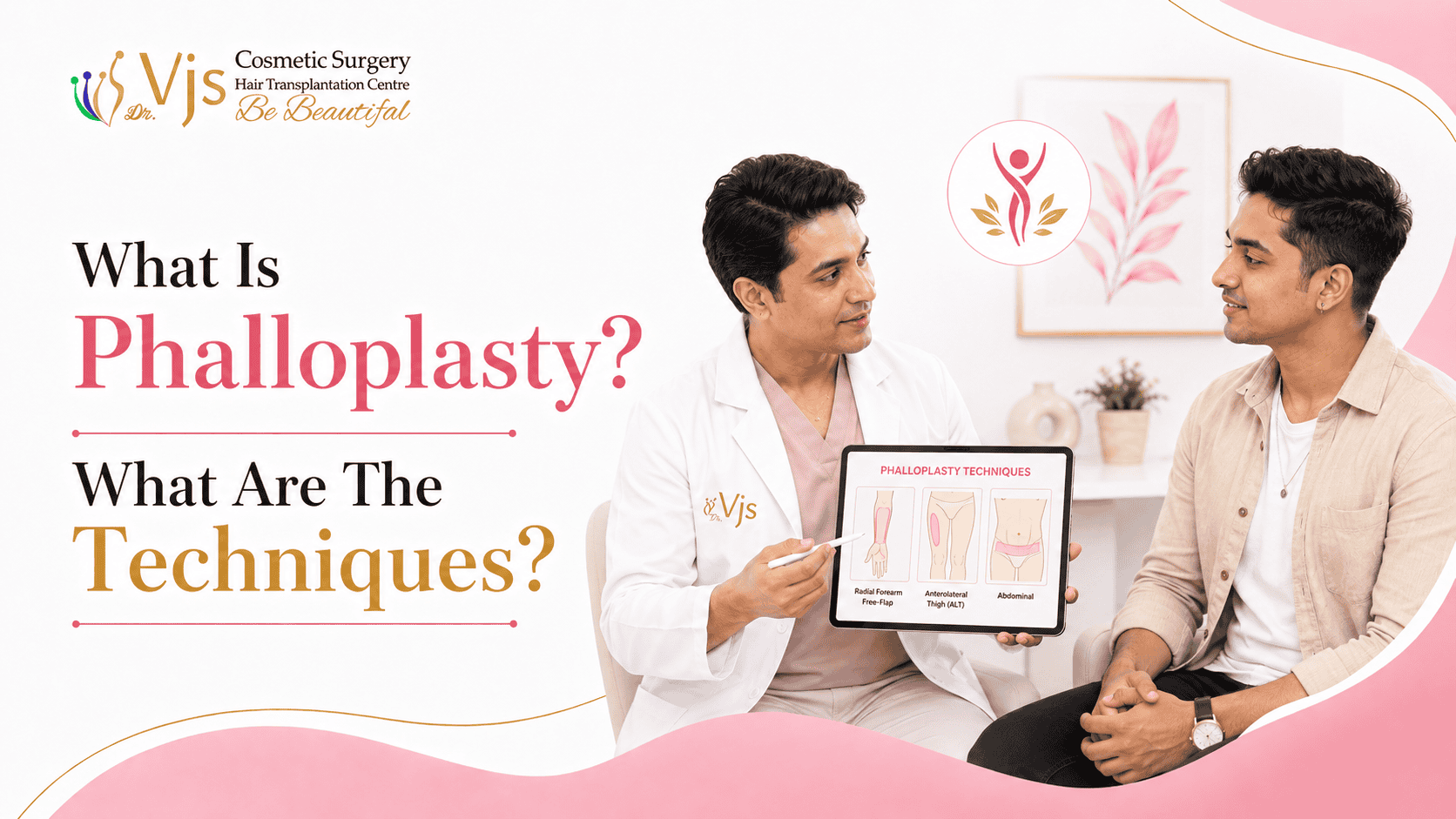
Phalloplasty: Techniques, Stages, Goals and Important Limitations

Phalloplasty is a complex reconstructive procedure that may be considered for gender-affirming care, trauma, cancer or congenital conditions. Technique, staging, urinary function, sensation and recovery vary by individual.
Vaginoplasty: Indications, Techniques, Risks and Recovery Considerations
Vaginoplasty can refer to different reconstructive or gender-affirming procedures. The reason for surgery, technique, risks and recovery vary, so assessment should be individualized.